Category: Developing Thoughts

  • If you don’t know where you are going, any road will take you there

    If you don’t know where you are going, any road will take you there

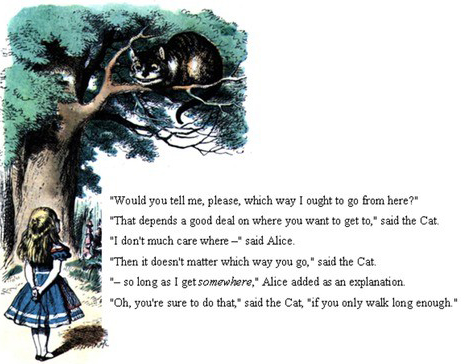
    “If you don’t know where you are going, any road will take you there”

    -to paraphrase Lewis Carrol, from Alice In Wonderland.

     It is that time of year once again. As with the beginning of every new year, everywhere you look people and pundits are telling you what you should do to improve the “old you”. “Exercise more.”, “Eat less.”, “Work harder.”, “Focus on quality time.”, “Spend less time on social media.”, “Read a book.”. There is no shortage of externally directed, “self-improvement” advice, most which you heard and failed to heed for any extended period last year. Sure, you made those “New Year’s” resolutions along with most everyone else, but why like most everyone else did they fail to become a habitual practice. Usually the answer is simply there was no immediate ROI (Return on Investment).

    In life, just like in business, most people want and expect a return on their investment. If they are going to spend their time and capital on exercise, they want the smaller belt or dress size or the six-pack abs (or at least not feeling like they will faint after slowly walking up a couple of flights of stairs). In fact, they more than just expect that ROI, they feel they are entitled to it. And indeed, in life as in business, this is a reasonable expectation. Other than the few, complete altruists amongst us or those who are part of the 1% club, we cannot afford to expect less if we make an effort. The problem of why we often don’t achieve or ever see that ROI is often more one of timing, than actual lack of effort.

    In business, as in our day to day existence, we are faced with an abundance of good ideas, many of which at their initial voicing, seem to illustrate a logical path or a highly rewarding strategy we should follow. The more immediate we stand to reap the benefits, or in other words the shorter the journey to success, the more attractive the suggested path appears. Unfortunately, it is rare we reach our destination quickly or easily. Just as it takes thousands of crunches and “planks” to build the “abs six-pack”, it takes a lot of phone calls, numerous meetings and briefings, and in many cultures a seemingly excessive amount of “tea drinking” to even begin to reach the point of tabling a proposal much less closing a deal. It is for these reasons, before we ever start on our journey a destination must be carefully selected, a path forward must be wisely designated and it must be clearly marked by “waypoints “(tangible activities or results). These “waypoints” will assist us in both marking our way and in realistically defining our timeline and rate of travel so that not only can we readily measure our level of success along the path, but even choose detours and off ramps if necessary.

    Our “waypoints” will not only serve to blaze our trail forward and keep us on track, they will also serve to help us manage the expectations of those who are “observing” the journey.  Often the advice voiced by those who aren’t slogging down the path can raise speed bumps and even obstacles, because they do not comprehend the trip as intimately as do the journeymen and women. “Waypoints”, or clearly defined and articulated intermediate objectives, will assist us in explaining where we are headed in addition to aiding us in getting there – the point of profit.

    Unlike Alice, we must clearly define and mark our path, as it is critical to us getting where we want to go, rather than simply having us arrive “somewhere”.

    Now that is a resolution I believe we can all agree to make a habit.

  • Why do so many people believe anyone can be a business developer?

    Why do so many people believe anyone can be a business developer?

    This is a phenomenon I encounter time and time again.

    This is a phenomenon that time and time again leaves me shaking my head incredulously.

    It is rare that someone is either so delusional or so egotistical that they believe, without any training or experience, they can be an engineer, a doctor, a supply chain management specialist, a nurse, a cosmetologist, or an astronaut. Yet that does not appear to be the case with sales and marketing. I repeatedly find that the vast majority of people I meet in business believe they can be a business developer.

    Years ago, I remember hearing a story of a General and his driver who were tasked with traveling to the various military installations on the east coast and briefing the spouses of the deployed soldiers on the various programs and support networks available to families while the soldiers were deployed. One after another they hit the bases and the General gave the briefing while his driver flipped the PowerPoint slides. While enroute to yet another base, the two were talking as they were driving along and the driver asked the General, if didn’t he get tired of giving the same pitch again and again?

    The General replied no not at all; and while it may seem to the driver that every briefing was the same, every briefing actually was subtlety different and each had its own set of challenges. The driver replied, “Well I respectfully disagree with you General. In fact, I think it is so easy and I have listened to it so many times I could give the briefing at the next base.” The General paused in thought for a moment and then said okay – next stop you give the briefing and I will flip the slides.

    At the next installation, having swapped uniforms, the two took to the stage and began the briefing. As the General flipped the slides the driver moved rapidly through the information with not too much problem. During the question and answer period however, each question became a little more complex, and he increasingly struggled to respond as the extremely quizzical spouses were besieging him with concerns. Finally as the questions increased in quantity and complexity he had a spouse stand up and make a particularly involved query. Completely stumped and on the verge of panic, he hesitated for only a moment, then quickly responded, “Why that is so simple, I am going to let my driver answer it for you.”

    While this may be a somewhat lame anecdote, it does reflect a situation all too common in many organizations. This is a modus operandi all too often exhibited by the, “helicopter business developers”. These are the folks who believe, that simply by periodically flitting in and out of the marketplace, (usually by attending shows, conferences, and seminars); not being held responsible and accountable for developing the business and making sales; and not doing the day-to-day, week-to-week, and usually month-to-month  “nug” work so essential to developing business relationships,  they are in fact “developing the business”.  Therefore, in their minds they believe they are business developers.

    Now granted, to their credit very few of these people actually profess any desire to pursue the business development career path. In their minds however (as evidenced by the free and willing advice they are quick to dispense to all who may be within earshot) they could easily do the BD job if they wanted to.

    Why this fact amazes me so much is that prior to my entering the field of business development, my sense of capabilities never included the concept that I could successfully sell anything, much less help others achieve the same results. I in fact was quite humbled by those I saw as being incredibly gifted and talented at “closing the deal”. I saw it then, as I do now – it is a real skill.

    The man who makes an appearance in the business world, the man who creates personal interest, is the man who gets ahead. Be liked and you will never want.
    Death of a Salesman, Arthur Miller
    Willy Loman, Act 1

    As I gained experience and was mentored by these “G&T” individuals, I realized even more that Business Development was not only a “Willie Loman” like art form, but was also a science or process. While every member of the organization is responsible for “growing the business”, it takes trained and focused Business Development professionals to systematically achieve business growth. Sales are different from business development. By recognizing Business Development as a science or process, I realized that there were certain principles that could then be learned, taught, and then followed. Achieving this knowledge provides the foundation required to be a successful business developer. Practicing the knowledge is what sets apart the successful Business Developers.

    It is this knowledge, both how to achieve it and how to execute it, that Alternate Axis shares with its clients.

    This knowledge will also be the focus of our future discussions.

  • It takes Money to Make Money – The Question Is, How Much?

    It takes Money to Make Money – The Question Is, How Much?

    There is a great deal of debate whether there is any truth to the old adage, “It takes money to make money.”

    If you are a promoter of get rich quick, pyramid schemes or a realtor engaged in the sale of site un-seen, beach front property or multi acre, mountainside retreats, the folks who provide you your initial “business development training” would have you believe it will not cost you one thin dime (at least of your own money) to make your fortune.

    On the other hand, if you were a well-heeled, Fortune 500 company, or even a middle-tier supplier or manufacturer of repair parts or components intent upon expanding lagging sales in this ever-challenging market, you would normally be expected to follow a more conventional business development (BD) strategy.

    The conventional BD strategy is to put more money into flagging business development efforts by hiring more people, engaging in more conferences, attending more trade shows and in general exercising a shotgun approach to expanding sales under the belief that if some BD effort is good, more BD effort is better. It is generally an all-consuming strategy, involving a great many resources (time, effort, managing, and mentoring to name a few), with a potentially limited return. In other words, by default you subscribe to the “It takes money to make money” philosophy. Since you apparently embrace the theory that to grow, investment is necessary, the logical question that should then follow is, “How much money does it [should it] take?”

    “Remind people that profit is the difference between revenue and expense. This makes you look smart.”

    Scott Adams


    As someone who has run several major business development organizations, I am well aware of the overhead and “waste” of resources inherently associated with these BD teams. I say inherent because this “waste” is not due at all to the members of the organization, but more so due to the intrinsic cost associated with permanent employees, their benefits, and the cost of the bureaucracy to manage them. Traditionally this has been the way organizations have pursued business:  growing people from within; using internal assets; pursuing any and all “leads” and “opportunities” (generally translated to mean everyone on the team attending every trade show and conference – together), rather than focusing on specific targets, or “following the money.” In other words, doing it the way we have always done it.

    “Whenever you find yourself on the side of the majority, it is time to pause and reflect.”

    Mark Twain


    There is however a different way to approach augmenting your BD efforts; instead of bringing on board a new, un-proven, permanent hire who will be more expensive and take longer to train to be productive, you could hire a professional, experienced, and proven BD consultant on a contract basis.

    A BD consultant will work directly for you, without the associated overhead and incidental costs. Capable of being focused completely on prospective customers and markets, a BD consultant will adapt and work within the marketing and business development systems in place, but should you require, is flexible enough to examine your specific situation and create a program that takes advantage of the strengths you’ve already worked to establish.

    Put another way, they will tailor their efforts to maximize the current sales/marketing/administrative activities already in place within your office. Their initial focus is on determining which prospects should be contacted and what markets should be focused on in order to bring in new business to your company. All of this work will be performed more efficiently and at a lower cost than bringing on permanent employees. There is no “waste” in either time or talent, and your company pays for results not simply for attendance.

    There are additional advantages to be gained from bringing a proven, professional BD consultant on board -cross-pollination of ideas and an external perspective on your business.  This allows an opportunity for external analysis and the potential for change and growth. The ability of the BD consultant to bring to the table an extensive networking capability only further “sweetens” the professional relationship.

    The business development environment is changing. Opportunities, while still out there, require a whole new skill set to pursue successfully; that skill set may either not be fully present in your organization or may require reinforcing. Bringing on board a BD consultant will help you capture those elusive opportunities. It will also readily assist you in answering the question of how much money it takes to make money

    You can take that to the bank!

    “The ladder of success is best climbed by stepping on the rungs of opportunity.”

    Ayn Rand